Project Themes
Language Policy and Literacy

by Dr. Yvette D. Hyter
Literacy , language use, and access to education significantly impact the lives of the women in Senegal . For example, 80% of the women in rural communities are illiterate. In 1992, the Senegalese government created a ministry of Adult Education and Literacy Teaching, which developed an action plan to increase literacy among the Senegalese populace. Two objectives of this action plan included (1) the teaching of literacy in national languages, and (2) the decrease in the disparities of geography (rural vs. city) and gender in literacy acquisition.
 The language policy in Senegal is that French is the official language - the language of "formal" schooling, the media, commerce, and the government, although only 10% of the Senegalese population speaks French, and it is spoken primarily in the larger cities (e.g., Dakar).
One of the most striking differences between Senegal and the United States, which does not have a national language policy, is that in Senegal, 25 different languages co-exist, 6 of which are named as national languages spoken by 86% of the citizens.
Language Policy and Literacy
by Dr. Yvette D. Hyter & Lamine Kane
 Language policy can be defined as "ideas, laws, regulations, rules, and practices" to change language use in a particular society or system (Kaplan & Baldauf, 1997). James Crawford (http://www.languagepolicy.net/) defines language policy as "what government does officially - through legislation, court decisions, executive action or other means - to (a) determine how languages are used in public contexts, (b) cultivate language skills needed to meet national priorities, or (c) establish the rights of individuals or groups to learn, use, and maintain languages."
In Senegal , the language policy is that French is the official language - the language of "formal" schooling, the media and the government. Interestingly, only 10% of the Senegalese population speaks French, and it is spoken primarily in the larger cities (Dakar for example). Although this policy exists, one of the most striking differences between Senegal and the United States (which does not yet have a national language policy although several states [currently 26 ~see James Crawford's web page] have adopted an English Only language policy).
Imagine going through 14 or more years of schooling, never hearing one negative word about the language you speak or the way you speak it (personal communication from Senegalese woman educated in Senegal). It is unimaginable to me and to many children of color in the United States who speak a language variety other than standard American English dialect. Currently 47 - 51 million individuals living in the United States speak a language other than English in their homes (http://www.ethnologue.com/show_country.asp?name=Senegal).
The children in Senegal, however, grow up speaking/learning at least seven different languages, some national languages(http://www.africaguide.com/country/senegal/culture.htm#lang ) such as Wolof, Pulaar [Fulani], Sérère, Jollah [Diola], Malinké, and Soninké), the official language (French), as well as tongues of other countries (Italian, Spanish, Portuguese). As a result of the French Assimilation Policy, French is taught in school, and is the medium of education, but the other languages are learned in various ways. For example, one young lady told me that she learned the seven languages that she spoke from her neighbors and friends. A picture of the school library at College Sacré coeur shows several European language books (French, English, and Spanish) that are used by children to prepare for the possibilities of going abroad (see pictures for Curriculum Artifact Box #2)..
Although the Senegalese teachers use French as the medium of instruction, they do not practice discouragement of using one's mother tongues. Some teachers, also fluent speakers of some national languages of Senegal , use the national languages in the classroom to assist the students in understanding concepts in French particularly in the first three years of primary education. In other words, there is an "unspoken" or de facto practice of using national languages as a bridge to learning concepts in the official language.
 Several individuals in Senegal , women, men, young students, recent graduates, people who lived abroad, all reported not having been made to feel "badly" about their own language or never feeling like they had to choose between one language and another. There is support in the schooling system for the use of national languages, and support in the community for maintaining national languages. This support for national language use also is present in the media, particularly in private radio stations and state television. While this linguistic support system exists, there does seem to be some concern among some speakers of particular national languages that Wolof, the lingua franca spoken by 90% of the population in Senegal and the West African region, is becoming the preferred linguistic system over the other national languages.
Some children whose national language is, for example Sérère, converse with their playmates in Wolof (the common national language between them) and therefore, prefer to converse in their homes in Wolof rather than their own national language - Sérère.
 Historically , literacy has been defined in many ways. In the U. S., one used to be considered literate when able to simply decode words, but now (2004) to be considered literate one must not only be able to decode words, but also be able to make inferences in text, to read a variety of different types of texts (stories, poems, reports, etc.) and to make connections between what they read and their daily lives (Linebaugh, 1993; Santiago-Valles, 2001; Westby, 2004).
The question of how literacy is defined was raised while we were in Senegal (2003). Children learn to read and write Arabic, the language of religion. This type of literacy is linked to understanding the Qu'ran and is taught in the daaras. The children use Qu'ranic writing boards to practice writing passages from the Qu'ran.
Literacy, language use, and access to education significantly impact the lives of the women in Senegal . It is reported that the rate of illiteracy is high (60% for women and 50% for men) [Note# 6]. In 1992, the government created a ministry of Adult Education and Literacy Teaching and in 1994 this ministry developed a 10-year action plan to increase literacy among the Senegalese (personal communication in Lamine Kane, June 23, 2003 , Dakar , Senegal ). Two objectives of this action plan included (1) the teaching of literacy in national languages, and (2) the decrease in the disparities of geography (rural vs. city) and gender in literacy acquisition.
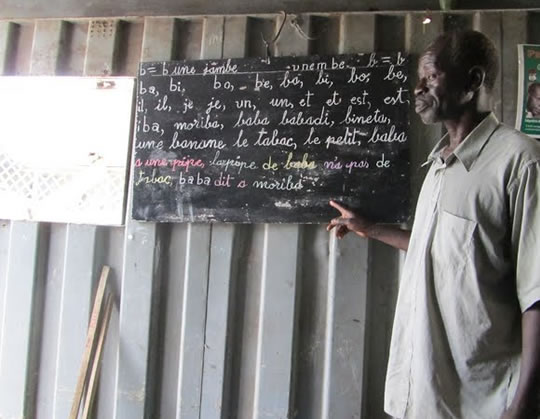
Individuals, particularly women, living in rural areas have a higher rate of illiteracy than those urban areasin (see picture). In regions such as Diourbel, Tamba, Kolda, and Louga, the illiteracy rate can be as high as 80 - 90%. In Kaolack, Thies, and St. Louis , it is 65- 75%, where as in Dakar the rate of illiteracy is much lower. ( The World Bank Female Literacy Project [WBFLP], 1996 ) The national language literacy campaigns are concentrated in the rural villages ( picture of women's literacy group with description of the work they are doing [ in the curriculum box # 2 = the writing slates and paper used in the women's literacy lessons in the rural villages]).
Women have the highest illiteracy rates primarily because females are less likely to be sent to school and more likely to stay home to help their mothers. This high rate of illiteracy impacts productivity rates and the education of the children. Children from illiterate mothers are 50% more likely to die in childhood. Also, illiterate women want 1 - 8 more children on the same income than literate mothers. Furthermore, literate mothers are 50% more likely to send their daughters to school than illiterate mothers (personal communication, Lamine Kane, 23 June 2003 ).
The World Bank has initially provided 13 million in U.S. dollars for literacy teaching in national languages; however, structural adjustment has forced cuts in the formal schooling system. For example, the government is not allowed to hire additional teachers. Many who teach for the formal schooling system are volunteers.
References
- Kaplan, R. B., & Baldauf, R. B. Jr. (1997). Language planning: From theory to practice (p. xi). Philadelphia , PA : Multilingual Matters.
- An official language is the language of government, education, commerce, and justice. In 1981 there was discussion ( at the All Parties Conference on Education , which was convened by the then socialist administration) of replacing French as the official language, but the government decided to keep French as the official language and that the national languages would be used only in literacy programs. As I talked with individuals about their preference for French or a national language as the official language, they preferred French. They felt that the institution of a national language as the official language would displace the other national languages and would be motivation for a civil war.
- In 1971 these six languages were officially promoted to national languages, although there are 5 other national languages that have been codified but this codification has not been significantly documented in the research literature. Consequently, these 5 languages (Hassaniya, Balant, Mankaan, Noon, Mandjaku) are not considered to have a critical mass of research and documentaion, and are therefore, not taught in school. Also, 14 other languages exist in Senegal. (Altogether there are 25 different languages in Senegal).
- The French assimilation policy was that Africans were to become like the French. The French wanted the Senegalese individuals to be like them, which was based on the assumption that all colonies of France would eventually become integral part of France . The ultimate goal was the political, cultural, and social integration of the colonized into the French nation. This was problematic because this policy was based on paradoxical assumptions: (1) that there was universal equality between man, and (2) that the European "civilization" was superior and if one did not have French culture, they had no culture at all (Lamine Kane, June 24, 2003, Presentation on the Language Policy in Senegal).
- Santiago-Valles, W. F. (2001). Comments . Group VII Meeting held on August 29, 2001 . Linebaugh, P (1993). The literacy of Robert Wedderburn, 1817. In J. Rule & R. Malcolmson (Eds.), Protest and Survival: Essays for E. P. Thompson (Chapter 6). Westby, C. (2004). Building blocks of 21 st century literacy. Symposium on Language and Literacy , Western Michigan University , February 2004.
- In 1988 80% of the young (15 - 39 year old) women were illiterate.( Project Document of the Female Literacy Project,financed by the World Bank ,1996).
- The "World Bank" is the name that is used to refer to the International Bank for Reconstruction and Development (IBRD) and the International Developmental Association (IDA). These organizations provide low interest loans, interest free credit, and grants to developing countries (The World Bank Group Web Site).
- Structural adjustment is a policy developed by the International Monetary Fund and the World Bank to reduce government spending. This reduction is made by limiting imports, devaluing the currency, limiting the civil service. These cuts in public spending badly affect social services, particularly health and education. In education for example:the emphasis was put on quantity at the expense of quality. To illustrate this, I 'll quote the remarquable progress in enrollment rates that are increasing in the elementary but the teacher/student ratio is nearing in some big cities 1/ 90. Furthermore every 3 pupils in the primary share 1 reading book, while every 5 share one math book. Repeating and dropout rates are still very high. This shows the low efficiency of the Senegalese education system.